

Is It Better to Take the ServSafe Food Manager Exam in English or Spanish?

Choosing the Right Language for Your ServSafe Food Manager Certification
If you are preparing for your ServSafe Food Manager Certification, one important decision is whether to take the exam in English or Spanish. Eligible candidates may have the option to take the ServSafe Food Manager Exam in either language, depending on the available exam format.
But which language is best for you?
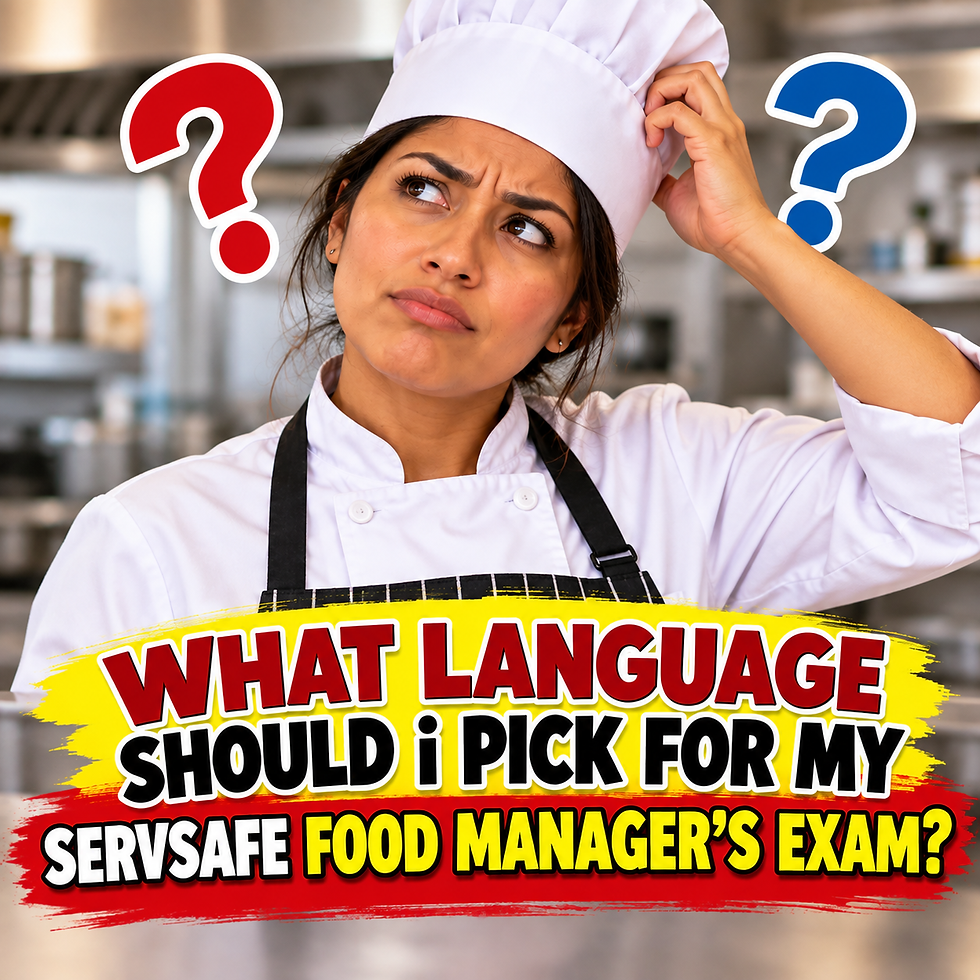
The answer depends on your reading comprehension, familiarity with food safety terminology, and the language you feel most comfortable using in a professional setting.
At Westchester Food Safety, we help food service professionals prepare for their certification by making food safety concepts easier to understand and apply in the workplace.
1. Taking the ServSafe Exam in English
Taking the exam in English may be the best choice if you regularly read, write, and communicate in English at work.
Advantages include:
You may already be familiar with common food safety terminology used in restaurants.
Many workplace procedures, training materials, and health department documents are written in English.
You can become more comfortable with the terminology used in English-language food safety training.
It may be easier to connect your exam preparation with the language used in your daily work.
However, if English is not your strongest language, reading complex questions under exam conditions can add an unnecessary challenge.
2. Taking the ServSafe Exam in Spanish
For Spanish-speaking food service professionals, taking the exam in Spanish may make it easier to understand the questions and demonstrate their knowledge of food safety.
Advantages include:
Questions may be easier to understand if Spanish is your primary language.
You can focus more on food safety concepts instead of translating every question.
Studying complicated subjects, such as time and temperature control, cross-contamination, and foodborne illnesses, may feel more manageable.
You may feel more confident when interpreting exam questions in your preferred language.
Keep in mind that you should confirm the Spanish exam’s availability and format with your training provider before scheduling.
3. Is the ServSafe Exam Easier in Spanish?
Not necessarily. Taking the exam in Spanish does not automatically make it easier.
The language you choose affects how comfortably you understand the questions, but you still need to learn the required food safety principles.
These topics include:
Preventing foodborne illness
Proper handwashing and personal hygiene
Preventing cross-contamination
Cooking, cooling, and reheating food safely
Understanding the temperature danger zone
Cleaning and sanitizing
Food allergies and allergen cross-contact
Pest prevention and facility management
Food safety management systems
The best choice is the language in which you can read carefully, understand the questions, and demonstrate your knowledge.
4. Should You Study in One Language and Take the Exam in Another?
Switching languages during exam preparation can sometimes create confusion.
For the best results, try to study primarily in the language in which you plan to take your exam. If you work in an English-speaking restaurant but understand food safety concepts better in Spanish, consider learning the important English terminology alongside your Spanish study materials.
Here are some useful terms to know in both languages:
English | Spanish |
Cross-contamination | Contaminación cruzada |
Foodborne illness | Enfermedad transmitida por los alimentos |
Temperature danger zone | Zona de peligro de temperatura |
Sanitizing | Desinfección |
Ready-to-eat food | Alimento listo para comer |
Understanding these terms in both languages can help you communicate more effectively with coworkers and management.
5. How Can You Improve Your Chances of Passing?
Regardless of which language you select, preparation is essential.
Choose your exam language early. Prepare using materials that match your intended exam language.
Review the major food safety concepts. Focus on temperature control, personal hygiene, cross-contamination, and foodborne illness prevention.
Practice answering questions. Practice tests help you become familiar with multiple-choice questions and identify areas that need more attention.
Understand the reasoning behind the answers. Memorization alone may not be enough when a question describes a real restaurant situation.
Get professional guidance if needed. An instructor can explain difficult concepts and help you focus your preparation.
6. ServSafe Food Manager Training in Westchester County, NY, for English- and Spanish-Speaking Students
Westchester Food Safety provides ServSafe Food Manager training opportunities for food service professionals in New York and Connecticut, with convenient access for students traveling from surrounding communities.
Our training focuses on helping students understand essential food safety concepts and prepare for certification.
Whether you are more comfortable studying in English or Spanish, choosing the right preparation approach can make a meaningful difference in your learning experience.
Before registering, confirm the availability of your preferred exam language and the applicable testing requirements.
7. Why Some Students Find the ServSafe Exam in Spanish Challenging
One concern occasionally raised by Spanish-speaking students is that some food safety terms in Spanish can feel more technical or unfamiliar than the English terms they are accustomed to hearing in a restaurant.
For example, a student who understands food safety through everyday workplace conversations may find certain formal Spanish terminology less familiar, even though Spanish is their preferred language.
This can be especially challenging when exam questions describe complex food safety situations involving temperature control, foodborne illnesses, sanitation, or food safety management.
Does This Mean the Spanish Exam Is Harder?
Not necessarily. The difficulty may depend on the individual student's familiarity with the terminology used in the exam and study materials.
A student who regularly studies food safety in Spanish may feel more comfortable taking the exam in Spanish, while another student who works primarily with English-language materials may find English easier to understand.
Our recommendation is to review food safety terminology in both languages before deciding which exam language best suits you.
Examples include:
Contaminación cruzada — Cross-contamination
Enfermedades transmitidas por los alimentos — Foodborne illnesses
Control de tiempo y temperatura — Time and temperature control
Desinfección — Sanitizing
Manipulación segura de alimentos — Safe food handling
At Westchester Food Safety, our goal is to help students understand the material, prepare confidently, and choose an exam option that fits their language skills and learning needs.
Final Thoughts: English or Spanish — Which Should You Choose?
There is no single right answer for everyone.
If you understand food safety terminology and exam questions more comfortably in English, choose English. If Spanish is your stronger language and helps you understand the material more clearly, Spanish may be the better option.
Your goal is not simply to choose a language. It is to understand food safety, prepare effectively, and earn your ServSafe Food Manager Certification.
Ready to prepare for your certification?
Westchester Food Safety — Helping food service professionals across New York and Connecticut build safer kitchens through food safety education and certification preparation.


Comments