

What to Expect During a Restaurant Health Inspection

A restaurant health inspection can be stressful, especially when you are not sure what the health inspector will be looking for. The good news is that being prepared can make the process much easier.

Health inspections are designed to help ensure that restaurants are handling food safely, maintaining clean facilities, and protecting customers from foodborne illness. Knowing what inspectors typically look for can help your restaurant correct problems before they become violations.
What Happens During a Restaurant Health Inspection?
When a health inspector arrives, they will generally review different areas of your food
establishment to determine whether your operation is following applicable food safety requirements.
The inspection may include:
Food storage and food temperatures
Employee handwashing
Proper food handling
Prevention of cross-contamination
Cooking and reheating procedures
Cold and hot holding temperatures
Food-contact surfaces
Cleaning and sanitizing
Personal hygiene
Pest control
Equipment and facility maintenance
Date marking and food labeling
Employee health practices
Proper chemical storage
Overall cleanliness of the establishment
The inspector may also ask questions about your food safety procedures and observe employees while they perform their normal duties.
Temperature Control Is Critical
One of the most important parts of food safety is temperature control.
Inspectors may check refrigerators, freezers, hot-holding equipment, and food temperatures throughout the kitchen. Foods that require temperature control need to be stored, cooked, cooled, reheated, and held according to applicable food safety requirements.
Restaurants should have accurate thermometers available and employees should know how and when to take food temperatures.
Handwashing and Employee Practices
Inspectors commonly pay close attention to employee hygiene.
Employees should understand when handwashing is required and how to properly wash their hands. Handwashing sinks should be accessible, supplied, and used appropriately.
Employees should also understand the importance of preventing bare-hand contact with ready-to-eat foods when required by the applicable food code and following proper glove-use procedures.
Cleaning and Sanitizing
A restaurant can look clean and still have food safety problems.
During an inspection, the inspector may examine food-contact surfaces, utensils, cutting boards, equipment, sinks, floors, walls, storage areas, and other parts of the establishment.
Employees should understand the difference between cleaning and sanitizing and know the proper procedures for both.
Cross-Contamination Prevention
Inspectors may look at how raw foods are stored and prepared in relation to ready-to-eat foods.
For example, raw meat should be stored and handled in a way that prevents juices or contaminated equipment from coming into contact with ready-to-eat foods.
Proper separation, storage, utensils, cutting boards, and employee practices all play an important role in preventing cross-contamination.
What If the Inspector Finds a Violation?
Finding a violation does not necessarily mean your restaurant is a bad operation.
Inspections are intended to identify areas that need improvement. Depending on the type and severity of the violation, the health department may require the problem to be corrected immediately or may provide a timeframe for correction.
The best approach is to take violations seriously, correct them properly, and make sure employees understand how to prevent the problem from happening again.
Don't Wait Until Inspection Day to Prepare
One of the biggest mistakes a restaurant can make is waiting until the inspector arrives to start looking for problems.
A better approach is to perform routine internal checks throughout the year.
Restaurant managers should regularly review:
Refrigerator and freezer temperatures
Food storage
Employee handwashing
Food labeling and date marking
Cleaning and sanitizing
Pest-control concerns
Equipment condition
Food preparation practices
Employee food safety knowledge
Required food safety documentation
Regular monitoring can help identify problems before they become health inspection violations.
How Westchester Food Safety Can Help
Westchester Food Safety can help restaurants prepare for health inspections and strengthen their everyday food safety practices.
We understand that running a restaurant is demanding. Managers and owners are responsible for employees, customers, food quality, inventory, regulations, and countless other daily responsibilities.
Our food safety services can help your team identify potential problem areas and improve food safety practices before an inspection takes place.
Mock Health Inspections
A mock inspection can be an excellent way to see your restaurant through the eyes of a health inspector.
Westchester Food Safety can conduct a mock inspection at your location, looking for potential food safety issues and areas that may need attention.
This gives management and employees an opportunity to correct problems and improve procedures before the actual health department inspection.
Food Safety Training
Proper training is one of the best ways to prevent recurring violations.
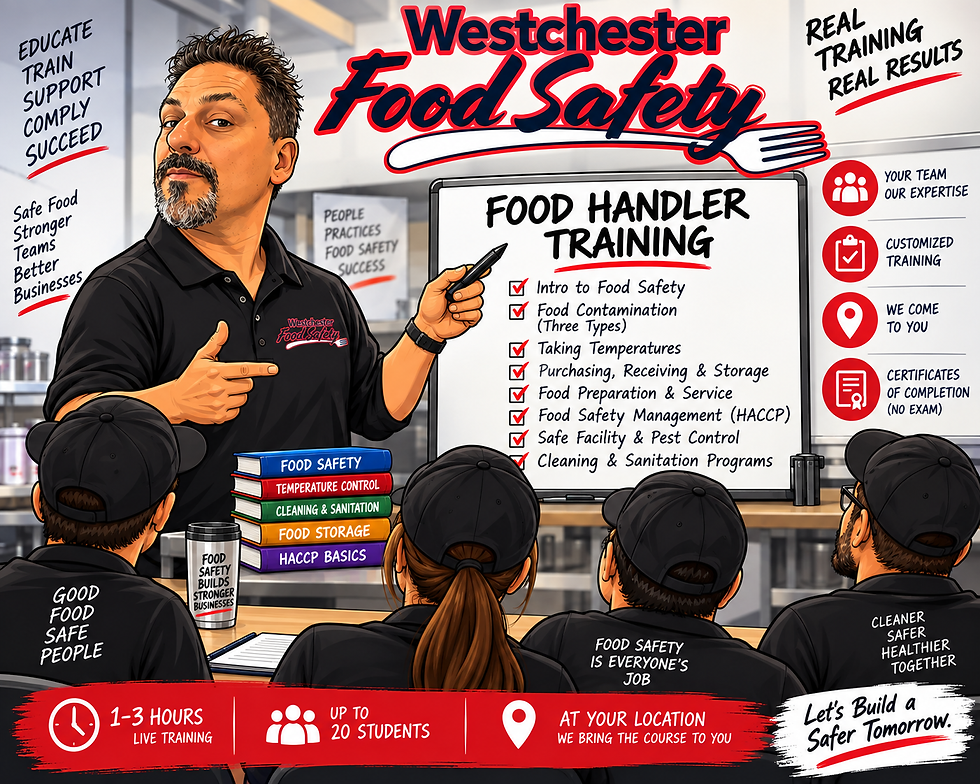
Westchester Food Safety provides ServSafe Food Protection Manager training and certification, as well as customized food handler training designed around the needs of your operation.
Training can help employees understand the reasons behind food safety requirements rather than simply memorizing rules.
Be Prepared. Don't Be Surprised.
A health inspection shouldn't be something your restaurant fears. It should be something your team is prepared for every day.
The goal isn't simply to pass an inspection. The goal is to develop food safety practices that become part of your restaurant's daily routine.
Westchester Food Safety is here to help.
From ServSafe Manager certification and food handler training to on-site mock inspections, we can help your restaurant improve food safety, prepare your staff, and identify potential problems before they become costly violations.
Contact Westchester Food Safety today to learn how we can help your restaurant prepare for its next health inspection.


Comments